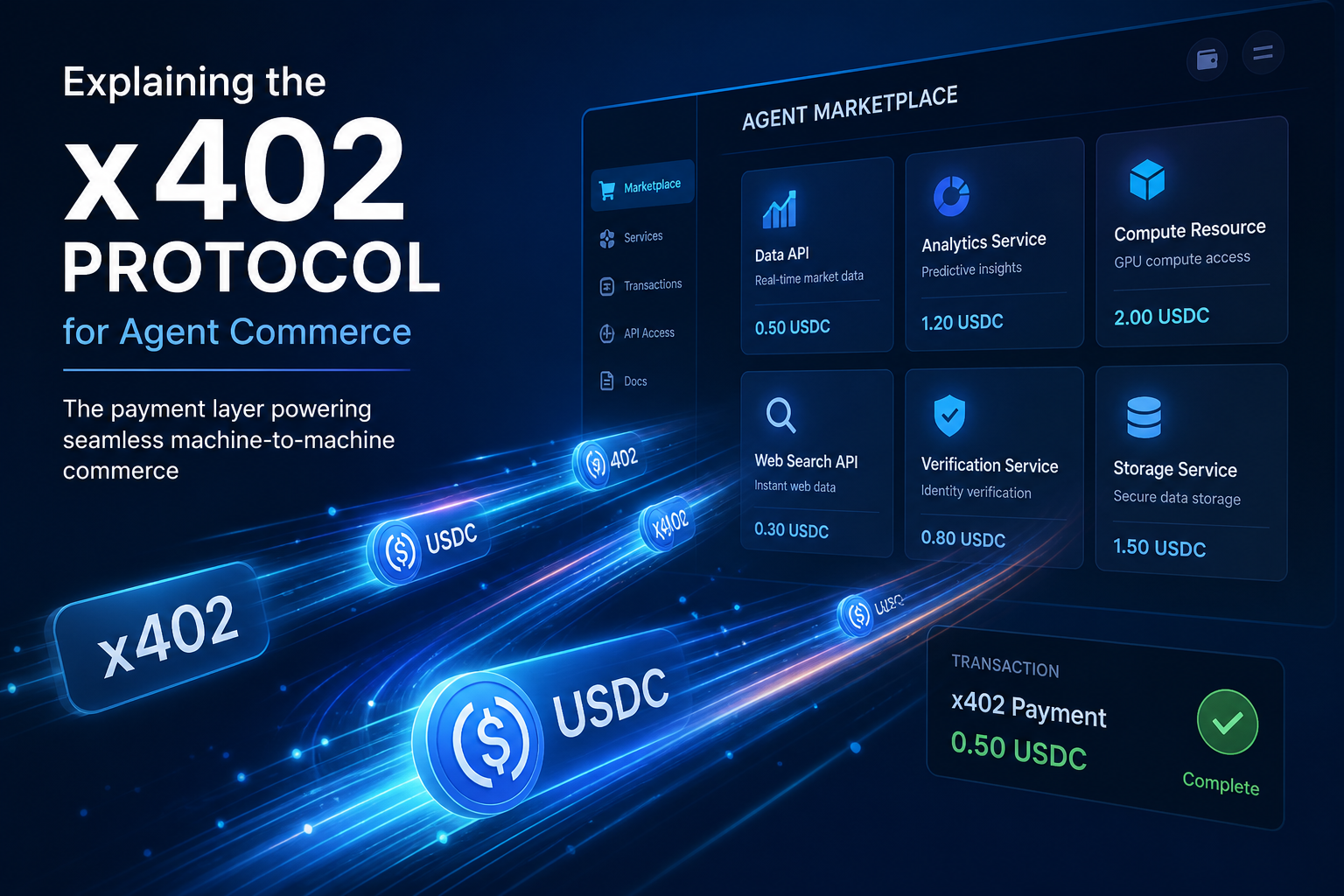
x402 Protocol for Agent Commerce: A Practical Guide
AI agents can search, plan, write code, and complete business tasks. Yet one important challenge remains: how does an autonomous agent pay for the resources it needs?
The x402 protocol for agent commerce offers a promising answer. Built around the long-reserved HTTP 402 Payment Required status code, x402 allows software agents to pay for APIs, data, computing power, and other digital services without relying on subscriptions or traditional checkout pages.
What Is the x402 Protocol?
x402 is an open payment protocol introduced by Coinbase. It turns online payments into a standard web interaction.
When an AI agent requests a paid resource, the server responds with an HTTP 402 message containing payment instructions. The agent can then authorize the requested payment and repeat the request with payment information attached. After verification, the server provides access to the resource.
The basic flow looks like this:
- An agent requests an API, file, or service.
- The server returns payment requirements.
- The agent signs or authorizes the payment.
- A facilitator verifies and settles the transaction.
- The server delivers the requested resource.
This process can happen in seconds and does not require a human to enter card details.
Why x402 Matters for Agent Commerce
Agent commerce describes economic activity performed by autonomous software. An agent might purchase market data, rent GPU capacity, pay for a research report, or call a specialized AI model.
Traditional payment systems were designed for people. They often require accounts, forms, billing agreements, and manual approval. Those steps create friction for machines.
The x402 protocol supports a more flexible model. Services can charge per request, per document, or per unit of computing time. Stablecoins such as USDC can provide fast settlement and predictable pricing, while blockchain networks handle payments across borders.
This approach also creates opportunities for smaller providers. A developer could publish a useful API and charge fractions of a dollar for each call instead of building an entire subscription platform.
Current Trends Supporting x402 Adoption
Several technology trends are strengthening the case for machine-native payments. AI companies are developing agents that can complete longer, multi-step workflows. At the same time, stablecoin infrastructure is becoming faster and easier to integrate.
Micropayments are also returning to the spotlight. Subscription fatigue has encouraged businesses to explore usage-based pricing, especially for APIs and AI tools. x402 fits this shift because payment requirements travel directly with web requests.
However, adoption still depends on reliable wallet controls, spending limits, security policies, and clear accounting. Businesses will need rules that define what an agent may buy, which providers it can trust, and how much it can spend.
The Future of Machine-to-Machine Payments
The x402 protocol could become an important building block for an open agent economy. Instead of negotiating contracts or managing dozens of API keys, agents could discover a service, understand its price, pay, and continue working.
x402 is still an emerging standard, but its use of familiar HTTP infrastructure gives it practical appeal. If developers, payment providers, and AI platforms continue supporting it, agent commerce may move from an interesting experiment to a normal part of the web.