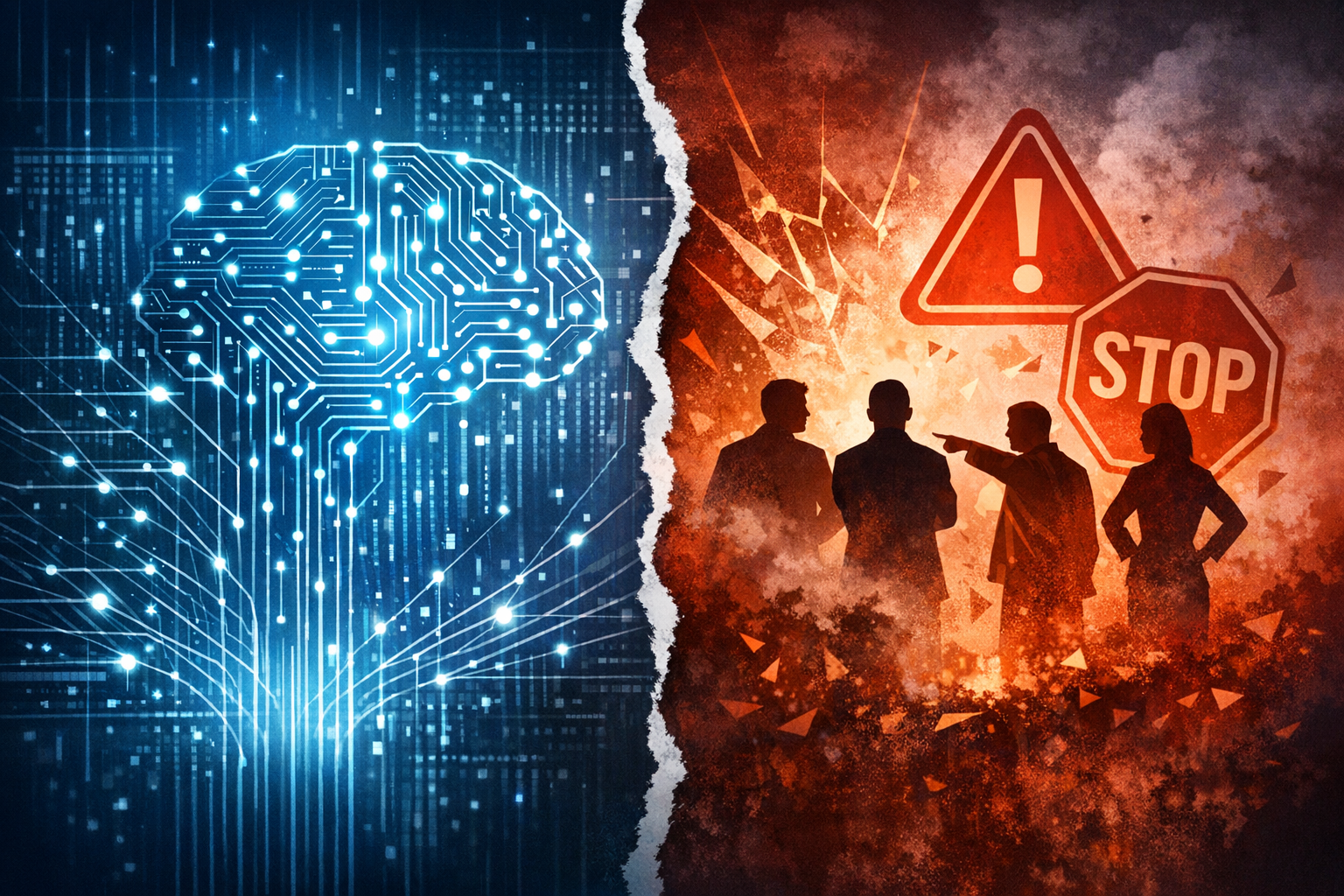
Anti-AI sentiment is no longer a fringe reaction reserved for technophobes or a small cohort of displaced specialists. It has become a visible cultural, political, and economic force.
From labor organizers and artists to educators, publishers, regulators, and everyday users, more people are asking a blunt question: if AI is so transformative, why does it feel so threatening?
The answer is not singular. Anti-AI sentiment is rising because artificial intelligence has entered daily life with unusual speed, uneven governance, and very real side effects. The backlash is not simply fear of machines. It is a response to power: who controls the systems, who profits from them, who bears the costs, and who gets to decide what counts as progress.
A backlash born from speed, scale, and opacity
One reason sentiment has hardened is the sheer velocity of AI deployment. In the span of a few short years, generative AI moved from experimental novelty to embedded infrastructure. It is now in search engines, productivity suites, customer service systems, coding tools, design platforms, recruiting software, and education products. That expansion has outpaced public understanding and, in many cases, institutional oversight.
When technology arrives faster than society can adapt, skepticism is inevitable. But AI has a particular problem: its systems often operate as black boxes. Users may see polished outputs, but they cannot easily inspect how models were trained, what data they absorbed, or why they produce specific answers. That opacity fuels distrust, especially when the consequences include misinformation, bias, or automation decisions that affect livelihoods.
Recent headlines have only sharpened the concern. Copyright disputes involving training data, lawsuits over voice cloning and likeness theft, and recurring stories about hallucinated outputs have created a narrative in which AI is not merely imperfect, but structurally untrustworthy. Each incident reinforces the perception that the industry is moving quickly while the public is left to absorb the fallout.
The labor anxiety is real
The most potent driver of anti-AI sentiment is economic fear. Workers do not need to imagine an abstract future of automation when companies are already using AI to reduce headcount, compress roles, or quietly de-skill entire functions. Writers, illustrators, translators, customer support agents, junior developers, analysts, and administrative staff are all confronting a simple reality: AI is no longer just a tool. In many workplaces, it is becoming a substitute.
This anxiety is not irrational. Even where AI does not eliminate a role outright, it can reshape it so aggressively that wages stagnate, job quality declines, and career ladders disappear. The traditional promise of “augmentation” sounds less convincing when employers use the same technology to justify leaner teams and higher output targets.
The debate has intensified as more firms publicly chase “AI efficiency.” In boardrooms, the language is framed as innovation. On the ground, it often sounds like redundancy. That disconnect is a major source of resentment. People are not rejecting technology in the abstract; they are rejecting the distribution of gains and losses.
Creatives feel particularly exposed
Few groups have responded to AI with as much intensity as artists and creators. Their objection is not only economic, though that matters. It is also moral and cultural. Generative systems have been trained on massive corpora of human-made work, often scraped without meaningful consent. For many creators, that feels less like inspiration and more like extraction.
The creative backlash has been amplified by the visual logic of generative AI itself. AI image and video tools can mimic style, flatten originality, and flood platforms with derivative content. The result is an environment in which creative labor can seem instantly replicable and therefore undervalued. If a machine can produce a “good enough” illustration in seconds, why pay a human rate?
That question has led to boycotts, union demands, watermarking campaigns, and public statements from major artists and publishing communities. The current trend is not simply resistance; it is the search for enforceable norms around consent, attribution, and compensation. The issue is no longer whether AI can imitate creativity. It is whether the creative economy can survive imitation at industrial scale.
Trust is eroding in information systems
Anti-AI sentiment is also rising because AI is colliding with an already fragile information ecosystem. Search engines now summarize answers with AI-generated overviews. Social media is flooded with synthetic content. Newsrooms are experimenting with automation under pressure to cut costs. Meanwhile, deepfakes and voice clones have made digital deception more convincing and more accessible than ever.
This has created a crisis of confidence. Users increasingly struggle to distinguish authentic content from synthetic material. For journalists, educators, and policymakers, that ambiguity is alarming. If a reader cannot trust an image, a quote, a transcript, or even a video clip, then verification becomes more expensive and public discourse more brittle.
The rise of AI-generated misinformation has turned abstract concern into practical paranoia. Election cycles, conflict zones, financial scams, and celebrity impersonation cases have all shown how synthetic media can be weaponized. As these incidents become more common, public sentiment shifts from fascination to suspicion. The technology may be powerful, but power without credibility is a liability.
Privacy and surveillance concerns are deepening
Another major source of resistance is the realization that AI often depends on vast quantities of personal and behavioral data. Many users now understand that convenience comes at a cost: prompts, interactions, preferences, voice data, camera feeds, and usage patterns can all become inputs for model improvement, personalization, or targeted monetization.
This has intensified fears around surveillance capitalism. In workplaces, AI-enabled monitoring systems can track employee performance with invasive granularity. In schools, AI tools may profile students or automate disciplinary decisions. In public spaces, facial recognition and predictive systems raise civil liberties concerns that feel increasingly difficult to ignore.
The point is not that all AI applications are inherently invasive. It is that the surveillance potential is enormous, and regulation has often lagged behind product rollout. The public is noticing. And once people believe that a technology watches as much as it helps, sentiment changes fast.
Regulation is arriving, but unevenly
Governments are finally moving, though the policy response remains fragmented. The EU AI Act has set a landmark framework for risk-based regulation. In the United States, federal action is more piecemeal, with agencies, states, and courts tackling issues like deepfakes, employment discrimination, and copyright one piece at a time. Other jurisdictions are pursuing their own standards, but global consensus remains elusive.
This unevenness matters because public distrust often grows in regulatory vacuums. When people do not see clear rules on transparency, liability, data provenance, or redress, they assume the worst. The current trend in policy is toward greater disclosure and accountability, but it may take years before those rules become visible in everyday products.
Until then, anti-AI sentiment will continue to benefit from a simple rhetorical advantage: skepticism sounds prudent when oversight looks weak.
Not all resistance is anti-innovation
It is important to separate reflexive pessimism from principled critique. Much of the opposition to AI is not anti-technology in the broad sense. It is anti-extraction, anti-opacity, anti-surveillance, and anti-displacement. That distinction matters.
In fact, some of the strongest critics are not outsiders but insiders: engineers, designers, ethicists, union leaders, and researchers who believe AI can be useful under stricter conditions. Their arguments tend to be more nuanced than the popular caricature of the anti-AI camp. They are not saying “never.” They are saying “not like this.”
That is why the rise in anti-AI sentiment should be read less as a rejection of progress and more as a demand for legitimacy. People are willing to accept powerful tools when those tools are accountable, bounded, and clearly beneficial. What they resist is a system that privatizes upside and socializes harm.
The path forward depends on trust, not hype
The AI industry is entering a new phase. The era of effortless enthusiasm is fading, replaced by a more demanding public conversation about value, ethics, and control. Companies can no longer rely on novelty alone. They must prove that AI improves outcomes without hollowing out jobs, compromising privacy, or degrading the quality of information.
That will require more than better marketing. It will require consent-based data practices, transparent model documentation, robust human oversight, compensation frameworks for creators, and genuinely enforceable safety standards. It will also require humility from vendors who have spent years promising disruption while underestimating the social cost of scale.
Anti-AI sentiment is rising because people are learning to interrogate the terms of adoption. And that is not a bug in the public mood. It is a feature of democratic accountability.
The future of AI will not be shaped by capability alone. It will be shaped by credibility. If the industry wants trust, it must earn it the hard way: through restraint, clarity, and evidence that progress does not have to come at society’s expense.