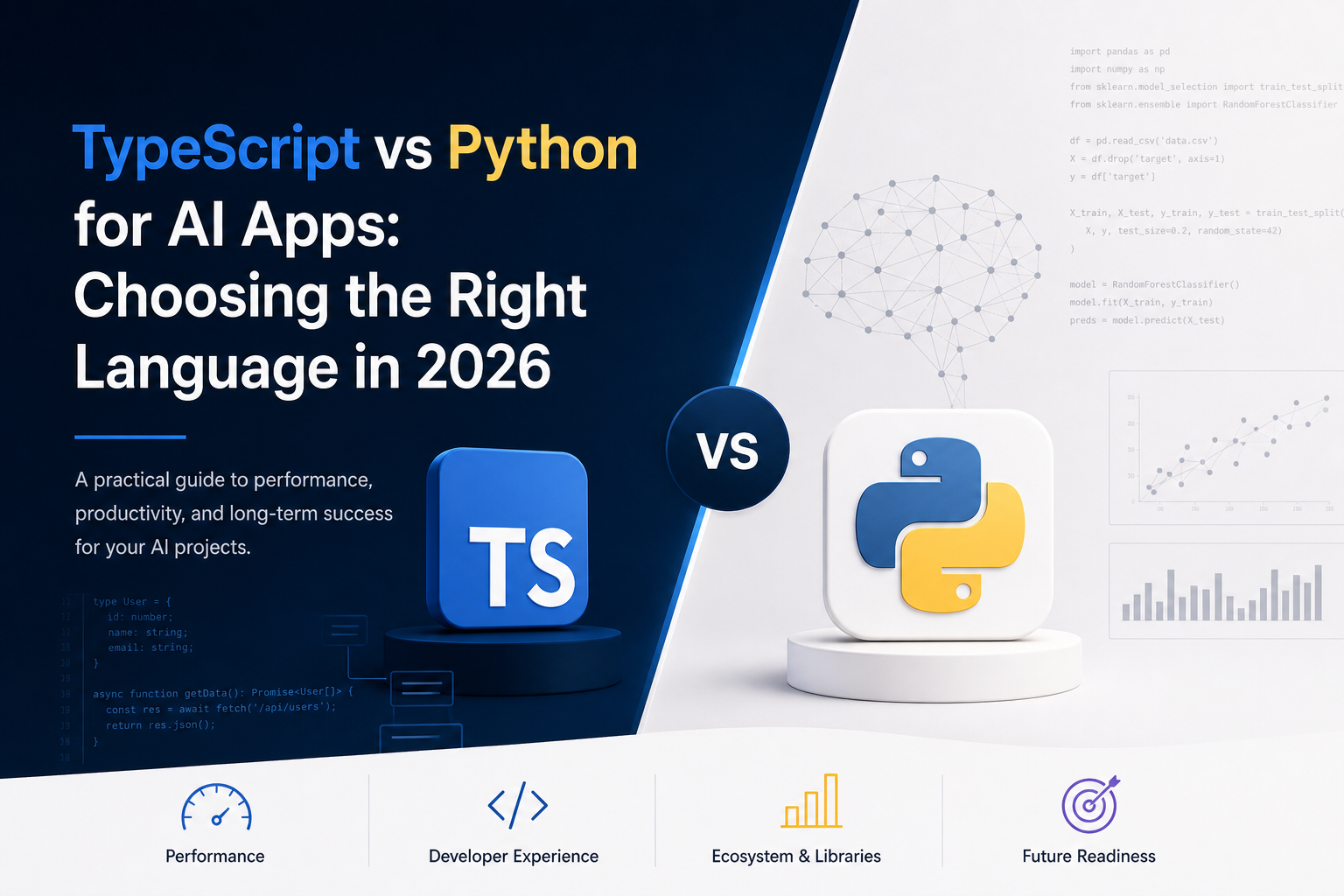
Choosing the right language for an AI app has never been more important. In 2026, the decision is no longer just about raw model training. Teams now care about speed to market, user experience, deployment simplicity, edge AI, agent workflows, and how easily a product can connect to APIs, databases, and front-end systems.
That is why the TypeScript vs Python debate keeps getting louder. Python remains the classic choice for machine learning and data science. TypeScript, meanwhile, has become a serious contender for building modern AI products, especially web-first apps and AI-powered platforms that need strong structure and scalable front-end integration.
So which one should you choose? The answer depends on what you are building, who is building it, and how fast you need to ship.
Why Python Still Dominates Core AI Work
Python continues to lead in AI research, model training, and experimentation. Its biggest advantage is the ecosystem. Libraries like PyTorch, TensorFlow, scikit-learn, Hugging Face Transformers, LangChain, and a growing set of agent frameworks make Python hard to beat for model work.
In 2026, many AI teams still use Python for:
- Training and fine-tuning models
- Data preprocessing and feature engineering
- Experimentation and research
- Building retrieval pipelines and evaluation tools
- Working with notebooks and internal ML workflows
Python also benefits from its simplicity. Data scientists, ML engineers, and AI researchers can move fast with fewer lines of code. For teams working close to the model, Python remains the default.
Another trend shaping Python’s role is the rise of open-weight models and local inference. More teams are running models on-premises or on private infrastructure for cost, latency, or compliance reasons. Python fits naturally into that workflow, especially when combined with inference servers, orchestration tools, and MLOps pipelines.
Why TypeScript Is Rising Fast for AI Apps
TypeScript has become a major force in AI product development because so many AI apps are now web apps. If your product includes a dashboard, chat interface, agent workspace, customer portal, or SaaS workflow, TypeScript gives you strong advantages.
In 2026, TypeScript is especially valuable for:
- Building full-stack AI apps
- Creating polished user interfaces
- Integrating with APIs and third-party services
- Managing complex app logic with type safety
- Sharing code across front end and back end
- Shipping faster with modern JavaScript frameworks
The rise of AI-native SaaS has pushed TypeScript further into the spotlight. Tools built with Next.js, React, Node.js, and serverless platforms make it easy to move from prototype to production. TypeScript helps teams catch errors early, which matters a lot in AI apps where prompts, tool calls, streaming responses, and structured outputs can get messy fast.
Type safety is a real advantage here. As more apps rely on JSON schemas, function calling, structured responses, and agent workflows, TypeScript helps enforce clean data contracts between services. That means fewer bugs and better maintainability.
The 2026 Trend: AI Products Need Both
The most important trend in 2026 is not Python versus TypeScript. It is Python and TypeScript working together.
This hybrid approach has become the standard for many modern AI teams. Python powers the model side, while TypeScript handles the application layer. For example:
- Python runs the model, vector search, or orchestration service
- TypeScript powers the web app, API gateway, and user-facing experience
- Shared schemas define inputs and outputs across both layers
This setup gives teams the best of both worlds. Python handles the AI-heavy tasks. TypeScript handles product delivery, interfaces, and integration. In fast-moving teams, this division of labor can improve performance and developer productivity.
The growth of AI agents has also encouraged this split. Agents often need backend logic, memory handling, tool execution, and UI feedback. Python is excellent for backend intelligence, but TypeScript is often better for building the interactive surfaces users actually see.
Performance, Scalability, and Deployment
If performance is your main concern, the question is more nuanced than many people think.
Python can be very fast when it delegates heavy work to optimized libraries, GPU runtimes, or external inference services. But for highly concurrent web apps, TypeScript can offer smoother scaling at the application layer, especially in serverless and edge environments.
TypeScript also fits well with modern deployment patterns. Many teams deploy AI front ends on Vercel, Cloudflare, AWS Lambda, or similar platforms where JavaScript and TypeScript are first-class citizens. This can reduce operational friction.
Python remains strong on backend services, but deployment can become more complex when teams combine ML dependencies, native packages, and infrastructure concerns. That said, Python has improved significantly with containerization, managed inference, and better packaging tools.
In practical terms:
- Choose Python for model-heavy workloads
- Choose TypeScript for user-facing, API-driven AI products
- Use both when building a complete AI platform
Developer Experience Matters More Than Ever
One of the biggest changes in 2026 is that AI development is no longer limited to ML specialists. Product engineers, full-stack developers, and startup teams are building AI features directly into existing apps.
TypeScript gives these teams a lower barrier to entry if they already know modern web development. Python is often better for teams with data science backgrounds or deep ML expertise.
Your team’s skills should influence the decision. The best language is often the one your team can use consistently, maintain confidently, and ship with quickly.
Which Language Should You Choose?
Here is the simplest way to decide.
Choose Python if you are building:
- ML models
- Training pipelines
- Data science tools
- Research prototypes
- Backend AI services with deep model logic
Choose TypeScript if you are building:
- AI web apps
- SaaS products
- Chat interfaces and copilots
- Front-end-heavy experiences
- Full-stack products with strong API workflows
Choose both if you want:
- A scalable AI product architecture
- Clear separation between model logic and app logic
- Faster shipping with fewer tradeoffs
Final Verdict
In 2026, Python is still the strongest language for AI model development, but TypeScript has become a top choice for building real-world AI products. If your focus is research, training, or backend intelligence, Python is the safer bet. If your goal is a modern, scalable, user-facing AI app, TypeScript may be the better option.
The smartest teams are no longer picking one language for everything. They are using Python for intelligence and TypeScript for experience. That combination is shaping the next generation of AI apps, and it is likely to remain the winning formula well beyond 2026.