The explosive growth of AI, cloud computing, and data-hungry applications is pushing traditional data centers to their limits. Power shortages, cooling demands, land constraints, and sustainability pressures are forcing the industry to innovate.
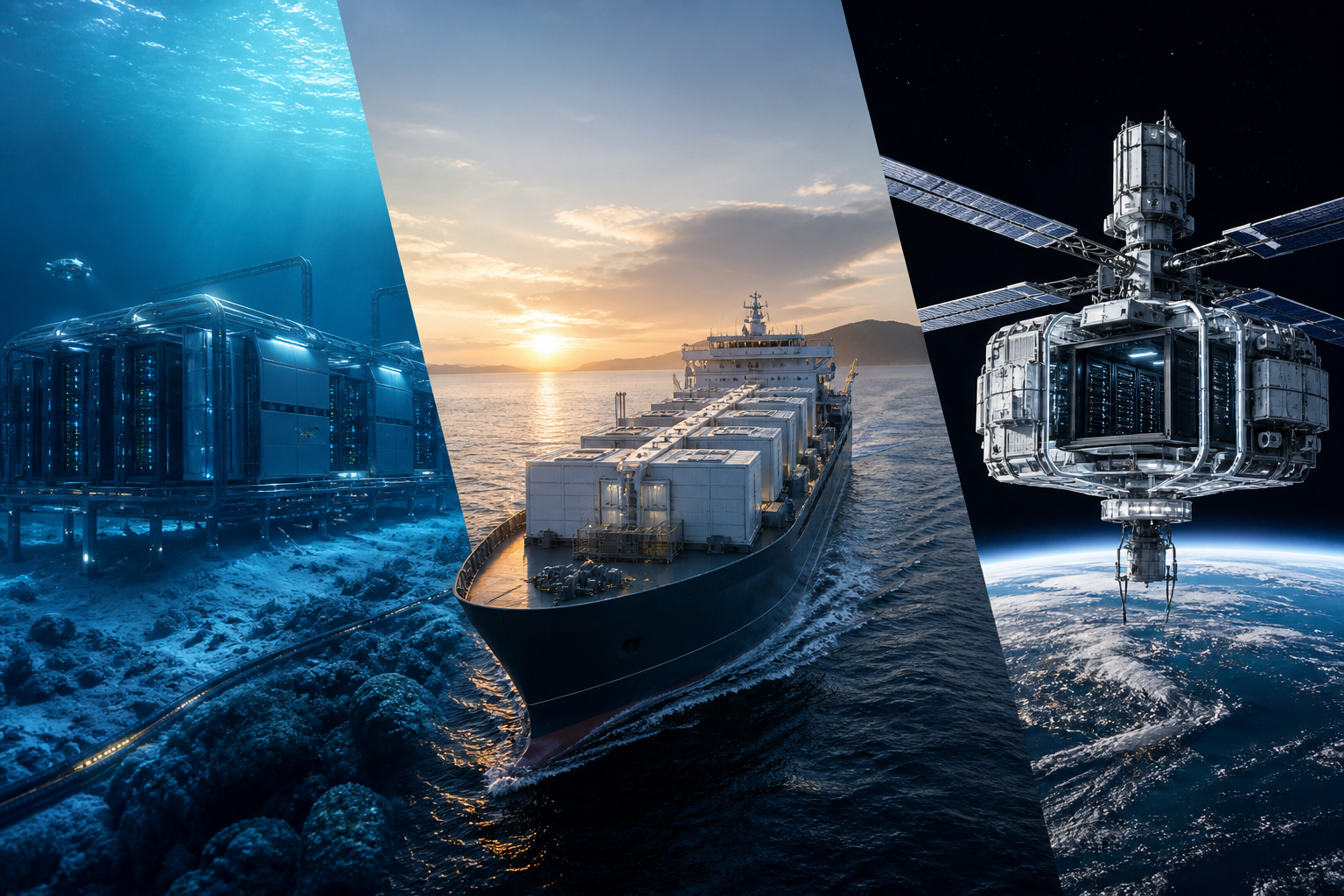
Enter the next frontier: unconventional locations like the ocean floor, floating vessels, and even orbital satellites. These concepts aren't science fiction—they're rapidly moving from pilots to commercial reality in 2025–2026.
This blog post explores the innovations, benefits, challenges, and implications of these next-generation data centers.
Underwater Data Centers: Nature's Cooling Superpower
Underwater (or subsea) data centers submerge sealed server modules in the ocean, using the vast, cold seawater as a passive heat sink. This eliminates much of the energy-intensive HVAC and chiller systems that can consume 30–40% of a traditional data center's power.
Pioneering Efforts:
- Microsoft's Project Natick (2018–2020): Deployed a 40-foot container with 864 servers 117 feet deep off Scotland's Orkney Islands. It ran for two years with server failure rates eight times lower than land-based equivalents, thanks to a stable, oxygen- and humidity-free nitrogen environment. The project proved feasibility but Microsoft has since paused active deployments while retaining learnings for reliability and immersion cooling.
- China's Rapid Scale-Up: China has taken the lead with commercial operations. A 1,300–1,433 ton facility off Hainan (around 35 meters deep) houses hundreds of servers, processing AI workloads equivalent to tens of thousands of high-end PCs. A larger 24 MW project near Shanghai (Lingang), powered by offshore wind and using seawater cooling, entered full operation in 2026 with ~2,000 servers. It supports massive AI tasks like processing millions of HD images quickly.
Advantages:
- Dramatic energy and water savings.
- Faster deployment (modules can be factory-built and towed).
- Enhanced security and reliability.
- Proximity to coastal populations for lower latency.
Challenges and Nuances:
- Maintenance requires specialized ROVs (remotely operated vehicles) or retrieval.
- Environmental concerns: potential marine ecosystem impacts, though sealed designs minimize leaks.
- Depth variations (shallow vs. deep water) affect pressure resistance and thermal stability. Deep-water deployments (>200m) offer even more consistent ~4°C temperatures but higher engineering costs.
- Regulatory and permitting hurdles for seabed rights.
Market projections are bullish: the underwater data center sector could grow from ~$3.2B in 2025 to $14.8B by 2034 at 18.6% CAGR.
Floating Data Centers on Ships: Mobile and Flexible Powerhouses
Floating data centers repurpose vessels or build purpose-designed ships for compute infrastructure, often paired with onboard or adjacent renewable power.
Key Developments:
- Nautilus Data Technologies: Operated a floating facility in Stockton, California, achieving significant efficiency gains via water-based cooling.
- Mitsui O.S.K. Lines (MOL) and Partners: Plans for retrofitting ships (e.g., car carriers) into data vessels, paired with "powerships" for renewable or flexible power. Targeting operations as early as 2027, with capacities from 23–73 MW. Hitachi is involved in feasibility studies.
- Other players like Samsung Heavy Industries are exploring similar concepts.
Benefits:
- Mobility: Deploy to areas with abundant power (renewables, nuclear barges) or high demand, then relocate as needed. Ideal for disaster recovery or temporary surges.
- Faster time-to-market (1–3 years vs. 5–8 for land-based).
- Reuse of existing maritime assets reduces costs and waste.
- Integration with offshore wind, tidal, or even floating nuclear power for low-carbon operation.
Considerations:
- Exposure to harsh marine conditions (storms, corrosion).
- Connectivity via subsea cables or satellite.
- Maritime regulations, crewing, and supply chain logistics.
- Edge cases: Hybrid models docking at ports or combining with shore power.
These offer a pragmatic bridge between traditional builds and more exotic underwater setups.
Data Centers in Space: Orbital AI Factories
The most ambitious vision: placing compute in low Earth orbit (LEO) or sun-synchronous orbits, leveraging near-continuous solar power and radiating heat into the vacuum of space.
Current Momentum (as of mid-2026):
- SpaceX/xAI: Elon Musk has outlined plans for massive orbital compute, potentially launching hundreds of GW annually. Starlink-derived laser links and satellite tech enable this. Prototypes expected soon.
- Axiom Space and Others: Deployed prototypes on the ISS; planning dedicated LEO nodes.
- Startups like Starcloud and proposals from Google (Project Suncatcher) and others for large constellations.
Potential Upsides:
- Abundant solar energy without grid constraints.
- Efficient radiative cooling in space.
- Low-latency edge processing for Earth observation or global networks.
- Scalability unbound by terrestrial land/power limits.
Huge Challenges:
- Economics: Launch costs, though falling, remain high. Radiation hardening, thermal management in vacuum, and repair difficulty.
- Latency for Earth users (though inter-satellite links help).
- Space debris risks, orbital congestion, and international regulations.
- Power transmission back to Earth or data downlink bottlenecks.
Experts are divided—some see it as transformative for AI scale; others highlight astronomical costs. Musk predicts more AI compute launched to space yearly than exists on Earth within years.
Broader Trends and Implications
The shift to these locations is driven by AI's insatiable appetite (projected global capacity doubling in years) amid terrestrial constraints like power grids and local opposition.
Sustainability Angle: Many leverage renewables (offshore wind, tidal, solar) and reduce water/land footprints, but full lifecycle impacts (manufacturing modules, launches) need scrutiny.
Edge Cases and Hybrids:
- Modular, containerized designs for rapid scaling.
- Integration with edge computing for low-latency applications.
- Sovereign data needs driving regional deployments.
- Hybrid terrestrial-aquatic-orbital architectures.
Risks and Considerations:
- Geopolitical: Control of undersea cables or orbital assets.
- Security: Physical (marine/ space) vs. cyber.
- Talent and supply chain for specialized engineering.
- Equity: Benefits concentrated among big tech/hyperscalers?
The Future Outlook: By 2030, expect a mix—underwater and floating for near-term efficiency gains, space for long-term breakthroughs. Innovation in cooling (liquid immersion, advanced materials), power (small modular reactors, renewables), and connectivity will accelerate this.
The next generation of data centers promises to be more resilient, efficient, and distributed. As AI reshapes our world, these unconventional homes for our digital infrastructure could define the decade. What location excites (or concerns) you most? Share in the comments.
This post draws on developments up to mid-2026. The field evolves quickly—stay tuned.